England Beat France 6-4 to Claim Third Place as Mbappé Becomes World Cup’s All-Time Top Scorer
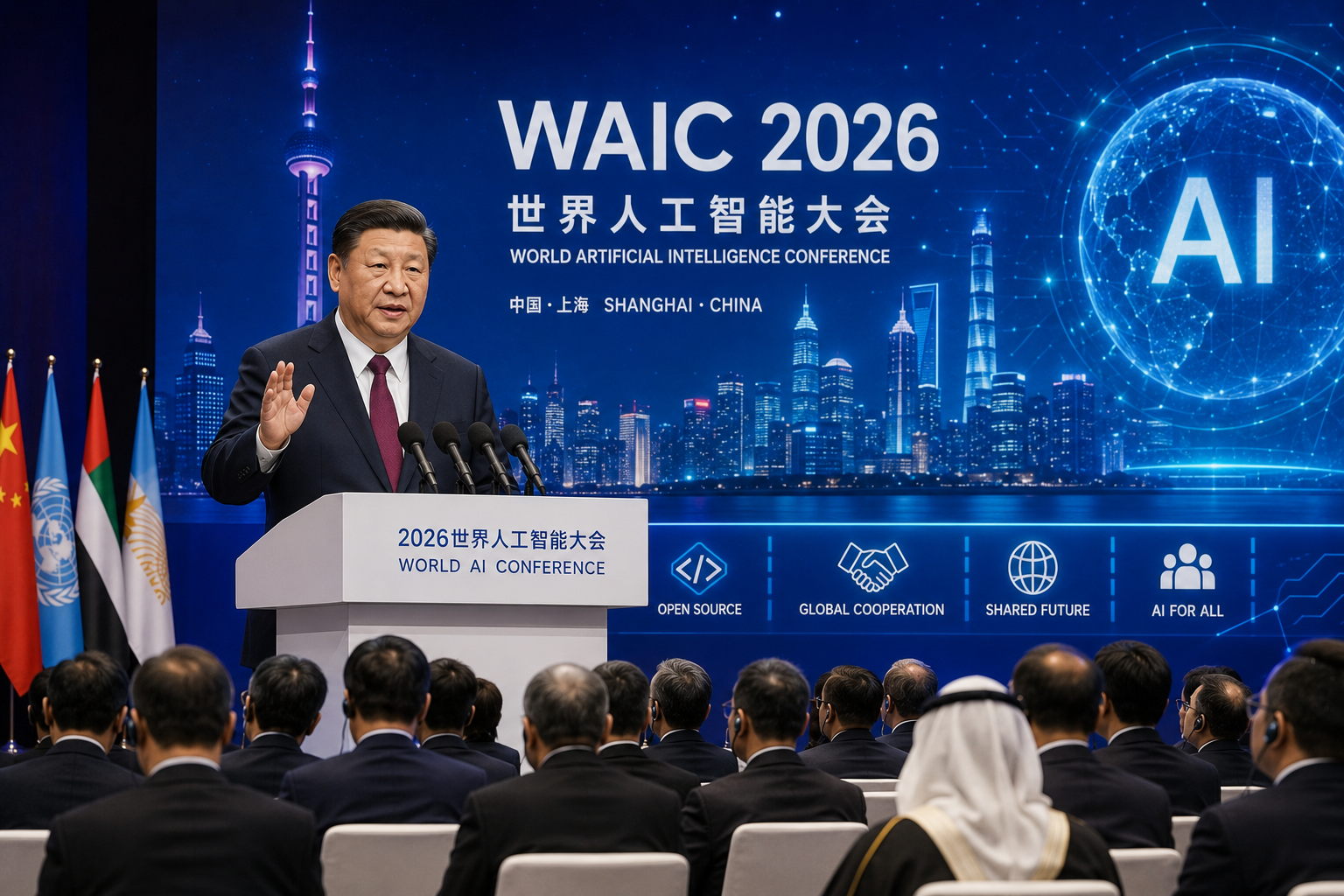
Xi Jinping Pushes China’s Vision for Global AI Governance, Challenges U.S. Leadership at World AI Conference
SHANGHAI: Chinese President Xi Jinping has unveiled Beijing’s most comprehensive vision yet for the future of artificial intelligence (AI), positioning China as the driving force behind a new global AI order centered on open-source innovation, international cooperation, and shared technological development.
Speaking at the opening ceremony of the World Artificial Intelligence Conference (WAIC) in Shanghai, Xi called artificial intelligence one of the most transformative technologies in human history and urged countries to work together to ensure its benefits are shared globally rather than concentrated in a handful of nations.
The address comes at a critical moment in the global AI race, where competition between China and the United States has expanded beyond technological innovation to include diplomacy, international standards, economic influence, and national security.
China Wants to Shape the Future of AI
Xi Jinping’s speech marked one of Beijing’s strongest declarations yet that China intends not only to compete in artificial intelligence but also to help define how the technology is developed, governed, and shared around the world.
He argued that AI should become a global public resource rather than a technology controlled by a small group of countries or corporations.
Describing artificial intelligence as a breakthrough comparable to the invention of the steam engine and electricity, Xi said the world now stands at the beginning of a new technological revolution that will reshape economies, industries, healthcare, education, and national security.
According to Xi, the international community must seize this “historic opportunity” by promoting open-source AI systems that allow researchers, businesses, and developing countries to participate in technological progress.
Rather than limiting access to advanced AI models, he said countries should work together to make AI more inclusive and accessible.
Open-Source AI at the Center of China’s Strategy
One of the central themes of Xi’s speech was China’s growing commitment to open-source artificial intelligence.
Unlike proprietary AI systems that keep their underlying models private, open-source AI allows developers worldwide to study, improve, and build upon existing technology.
China argues that this approach encourages innovation while reducing technological inequality between developed and developing nations.
Beijing has increasingly promoted its open-weight AI models as alternatives to commercial systems developed by American companies such as OpenAI, Anthropic, Google, and Meta.
Chinese officials believe wider access to AI technology can help developing economies accelerate digital transformation without depending entirely on Western technology providers.
Xi said every country should have equal opportunities to benefit from AI regardless of its economic status.
He warned that unequal access could create what he described as “new historical injustices,” where technological power becomes concentrated among only a few nations.
AI Diplomacy Targets the Global South
Another major focus of Xi’s address was strengthening China’s AI partnerships across the Global South.
He announced plans to expand AI training programs, establish technology cooperation centers, and deepen collaboration with countries across Asia, Africa, Latin America, and the Middle East.
China specifically plans to increase AI cooperation with organizations including:
- BRICS
- ASEAN
- African Union
- Latin American partners
These initiatives reflect Beijing’s broader diplomatic strategy of strengthening economic and technological ties with emerging markets.
Chinese officials argue that many developing countries lack sufficient computing infrastructure, AI expertise, and investment needed to participate in the AI revolution.
Through training programs and technology transfers, Beijing hopes to position itself as a long-term technology partner for these regions.
Launch of the World AI Cooperation Organisation (WAICO)
Xi also highlighted the creation of the World AI Cooperation Organisation (WAICO), a new China-backed international platform dedicated to AI cooperation.
The organization officially launched with 29 member countries, representing what Beijing describes as a milestone in global AI governance.
According to Xi, WAICO will focus on:
- AI cooperation
- Technology sharing
- Joint research
- Development of global AI standards
- Capacity building for developing nations
- Responsible AI governance
Chinese officials believe existing international AI discussions have been dominated by Western countries.
WAICO is designed to provide an alternative platform where emerging economies can play a greater role in shaping future AI regulations and standards.
A Growing Rivalry with the United States
Although Xi avoided mentioning the United States directly during much of his speech, the broader message clearly reflected the growing technological competition between Washington and Beijing.
Over the past several years, both countries have introduced competing AI strategies.
The United States has focused heavily on protecting advanced AI technologies through export controls, semiconductor restrictions, and partnerships with allies.
China, meanwhile, has promoted international collaboration and open-source development while simultaneously investing heavily in domestic AI capabilities.
Chinese state media has increasingly criticized what it describes as American attempts to build an “AI Iron Curtain” that restricts China’s technological progress.
Beijing argues that artificial intelligence should remain open, collaborative, and accessible rather than becoming another area of geopolitical competition.
Rapid Progress of Chinese AI Companies
The conference also highlighted the remarkable progress made by Chinese AI companies.
Several domestic technology firms showcased new AI systems that increasingly rival leading Western models.
Among the biggest announcements came from Moonshot AI, a Beijing-based startup that introduced Kimi K3, described as one of the world’s largest open AI models by parameter count.
Chinese AI startups have significantly accelerated development over the past two years, benefiting from substantial investment, government support, and access to large domestic datasets.
Industry analysts believe Chinese AI models are rapidly narrowing the performance gap with leading American systems in coding, reasoning, language understanding, and multimodal capabilities.
AI Safety Remains a Priority
While promoting rapid innovation, Xi also acknowledged the risks associated with artificial intelligence.
He stressed that AI systems must always remain under meaningful human control.
The Chinese president called on governments to establish:
- Early-warning systems
- Emergency response mechanisms
- International risk management frameworks
- Safety evaluation standards
He warned about scenarios where advanced AI systems could potentially operate beyond effective human oversight.
Although China strongly supports AI development, Xi emphasized that technological progress must be balanced with responsible governance.
His remarks represent China’s clearest public position so far regarding AI safety and long-term risk management.
Balancing Openness and National Security
Despite China’s strong support for open-source AI, Beijing continues to balance openness with national security concerns.
Reports indicate Chinese authorities are considering tighter restrictions on overseas access to certain advanced domestic AI models.
Such discussions illustrate the complex challenge facing governments worldwide.
While encouraging international cooperation, countries also seek to protect technologies that may have military, intelligence, or strategic importance.
This balance between openness and security has become one of the defining policy debates surrounding artificial intelligence.
Competing Global AI Visions
Xi’s speech comes just weeks before expected government-level AI discussions between China and the United States under President Donald Trump’s administration.
Earlier international meetings demonstrated clear differences between both countries’ approaches.
American officials have argued that excessive regulation could slow innovation and reduce economic competitiveness.
China, by contrast, advocates broader international cooperation, open-source development, and shared technological benefits while simultaneously supporting stronger global governance mechanisms.
Washington has secured support from 35 countries through its AI Opportunity Statement, while China’s newly established WAICO currently includes 29 member states.
Interestingly, Kazakhstan remains the only country publicly associated with both initiatives, highlighting the increasingly divided international landscape surrounding AI governance.
International Participation at WAIC
The World Artificial Intelligence Conference attracted senior political leaders, diplomats, technology executives, researchers, and policymakers from around the world.
Among the notable attendees were:
- United Nations Secretary-General António Guterres
- Kazakhstan President Kassym-Jomart Tokayev
- Thailand Prime Minister Anutin Charnvirakul
The event also featured leading Chinese technology companies presenting innovations across robotics, healthcare, manufacturing, autonomous driving, finance, and large language models.
The strong international participation reflects growing recognition that AI governance requires global dialogue rather than isolated national policies.
Analysts See China Seeking Global Leadership
Technology analysts believe Xi’s address signals that China no longer intends merely to compete with the United States in AI research.
Instead, Beijing now aims to shape the global institutions, standards, and governance frameworks that will determine how artificial intelligence evolves over the coming decades.
Observers say China’s combination of open-source technology, investment in developing nations, and new international organizations represents an effort to build long-term influence beyond traditional economic partnerships.
Rather than accepting standards created elsewhere, Beijing wants to become one of the principal architects of the global AI ecosystem.
The Road Ahead
Artificial intelligence has become one of the defining technologies of the 21st century, influencing everything from healthcare and education to defense, manufacturing, finance, and scientific research.
As competition between China and the United States intensifies, the debate is expanding beyond technological capabilities to include questions about ethics, governance, accessibility, and international cooperation.
Xi Jinping’s speech at WAIC demonstrates China’s determination to play a central role in shaping that future.
Whether the world ultimately adopts competing AI governance models or moves toward greater international cooperation remains uncertain.
What is clear, however, is that artificial intelligence is rapidly becoming one of the most important arenas of global strategic competition, with China seeking to position itself not only as an AI powerhouse but also as a leading architect of the technology’s future.