نجکاری کے عمل میں صارفین کے مفاد کو ترجیح دی جائے،وزیراعظم کی ہدایت
 ADMIN
ADMIN 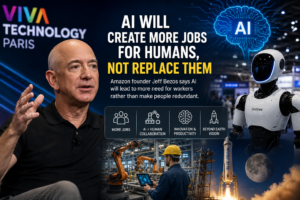
Jeff Bezos Says AI Will Create More Jobs, Not Replace Workers
PARIS: Amazon founder Jeff Bezos has dismissed growing fears that artificial intelligence (AI) will replace millions of workers, arguing instead that the technology will create more employment opportunities and eventually increase the demand for human labour.
Speaking at VivaTech Paris, Europe’s largest technology conference, Bezos presented an optimistic vision of AI’s future, saying the technology should be viewed as a tool that expands human potential rather than one that makes people obsolete. During the wide-ranging discussion, he also outlined his ambitions for space exploration, revealed updates on Blue Origin’s lunar plans, and discussed the growing role of humanoid robots and brain-computer interfaces in the future workplace.
His remarks come at a time when governments, businesses and workers around the world are debating how artificial intelligence will reshape the global job market.
AI Will Increase Demand for Human Workers
Addressing one of the biggest concerns surrounding artificial intelligence, Bezos strongly rejected the idea that AI would eventually replace most human workers.
“I know there’s a lot of concern that many people have, including many smart people, that AI is going to make humans redundant,” Bezos said. “I totally disagree with this point of view. I think AI is going to create a labour shortage.”
According to Bezos, AI will automate repetitive and time-consuming tasks, allowing people to focus on more creative, strategic and higher-value work instead of eliminating the need for human employees.
He argued that history has repeatedly shown how technological revolutions create entirely new industries and professions that were previously unimaginable.
From the Industrial Revolution to the internet era, advances in technology initially sparked fears about job losses but ultimately generated millions of new employment opportunities.
Bezos believes artificial intelligence will follow a similar path.
Technology Removes Barriers, Not People
The billionaire entrepreneur suggested that the world’s biggest limitation has never been a shortage of ideas but rather a shortage of resources, time and human capacity.
According to him, AI can remove many of these limitations by helping individuals and businesses become more productive.
Instead of replacing people, AI could enable workers to accomplish more in less time while creating entirely new sectors requiring skilled professionals.
He argued that as productivity rises, demand for goods and services will also increase, leading businesses to hire more people rather than fewer.
Bezos said innovation historically creates more economic activity, and AI is likely to continue that trend.
Different Views on AI’s Impact
Bezos’ optimistic outlook contrasts sharply with warnings from several political leaders, economists and technology experts.
Many analysts believe artificial intelligence could significantly disrupt labour markets over the next decade.
Former UK Prime Minister Rishi Sunak, who now advises Microsoft and AI company Anthropic, recently warned that AI is already affecting employment opportunities, particularly for younger workers entering the job market.
Several major companies have also acknowledged that AI is beginning to automate administrative, customer service and software development tasks.
As businesses increasingly adopt generative AI tools, concerns continue to grow about potential job displacement across industries such as finance, law, media, customer support and marketing.
Despite these concerns, Bezos believes the long-term economic benefits will outweigh the short-term disruption.
Prometheus: Bezos’ New AI Venture
During the conference, Bezos also discussed his latest artificial intelligence company, Prometheus.
The venture focuses on accelerating physical manufacturing through advanced AI technologies.
Manufacturing has traditionally relied heavily on automation, but new AI systems are enabling factories to become significantly more efficient by improving production planning, quality control, predictive maintenance and robotics.
Bezos said AI-powered manufacturing can help companies produce goods faster while reducing waste and improving overall productivity.
Rather than replacing factory workers entirely, he believes these technologies will create demand for new technical skills involving robotics, automation management and AI system supervision.
Labour Unions Remain Concerned
Not everyone shares Bezos’ optimism.
The UK’s Trades Union Congress (TUC) has warned that artificial intelligence could repeat some of the damaging effects experienced during past waves of industrial automation.
According to the union, poorly managed AI adoption risks degrading working conditions while concentrating economic gains among shareholders instead of employees.
The organisation argues that governments should introduce stronger protections for workers affected by technological change.
However, the TUC also recognizes AI’s enormous potential if implemented responsibly.
It believes employees should share the productivity gains generated by artificial intelligence through higher wages, improved working conditions and reduced working hours.
AI Is Expanding Beyond Chatbots
One of the strongest themes at VivaTech Paris was the rapid expansion of AI beyond text-based chatbots.
While conversational AI platforms remain popular, companies are increasingly integrating artificial intelligence into physical machines, industrial equipment and autonomous systems.
Visitors to the conference witnessed demonstrations showing AI controlling advanced robotics, manufacturing equipment and intelligent assistants capable of interacting naturally with humans.
Experts believe the next major phase of AI development will focus on combining software intelligence with physical automation.
This trend could transform industries including healthcare, logistics, agriculture, construction, hospitality and transportation.
Humanoid Robots Draw Major Attention
Among the biggest attractions at the conference was a humanoid robot developed by Chinese robotics company Unitree.
The robot attracted large crowds eager to see the latest advances in robotic mobility and human-machine interaction.
Unlike earlier generations of industrial robots that remained confined to factory floors, new humanoid robots are being designed to work directly alongside humans in everyday environments.
Developers envision future robots assisting hospitals, warehouses, hotels, restaurants, offices and even homes.
Advances in artificial intelligence now allow robots to understand spoken language, recognize objects, navigate complex environments and perform increasingly sophisticated physical tasks.
Brain-Controlled Machines Become Reality
Another remarkable demonstration featured collaboration between Unitree and French neurotechnology company HABS.
The companies showcased technology allowing users to control robots using brain signals instead of voice commands.
Participants wore an electroencephalogram (EEG) headset equipped with electrodes placed on the scalp.
The device measured electrical activity generated by the brain.
Artificial intelligence then interpreted these signals and translated them into commands for the robot.
Although still in its early stages, researchers believe brain-computer interfaces could eventually help individuals with disabilities control assistive technologies, prosthetic limbs and communication devices.
The demonstration highlighted how AI is increasingly being combined with neuroscience to create entirely new forms of human-computer interaction.
Bezos Looks Beyond Earth
Artificial intelligence was only one part of Bezos’ presentation.
He also shared his long-term vision for humanity’s future in space.
According to Bezos, the biggest obstacle to expanding human civilization beyond Earth is not demand but limited access to affordable space transportation.
He described space as “supply constrained, not demand constrained.”
In his view, making space travel cheaper and more frequent will unlock enormous economic opportunities over the coming decades.
Permanent Human Presence on the Moon
Bezos reiterated his long-standing belief that the Moon should become humanity’s first permanent settlement beyond Earth.
“We’re going to the Moon to stay, not just to visit,” he said.
He explained that the Moon offers several important advantages.
Its relatively close distance from Earth makes transportation easier than missions to Mars.
Additionally, lunar resources could eventually support long-term human habitation.
Bezos highlighted technologies such as electrolysis that may allow astronauts to extract hydrogen and oxygen from lunar water deposits.
These resources could then be used to produce rocket fuel directly on the Moon, significantly reducing the cost of deep-space exploration.
Such infrastructure could transform the Moon into a major transportation hub for future missions across the solar system.
Blue Origin Recovering After Rocket Setback
The conference also provided updates on Bezos’ space company Blue Origin.
Earlier this year, an uncrewed New Glenn rocket exploded during a ground test at Cape Canaveral, Florida.
Although the incident represented a major setback, Bezos described it as a valuable learning experience.
“It was a gut punch for the whole team,” he admitted.
Fortunately, no one was injured during the explosion.
Several critical launch systems also survived the accident, allowing reconstruction work to begin much sooner than expected.
Blue Origin Chief Executive Dave Limp told attendees that repairs are progressing rapidly.
The company expects launch operations to resume before the end of the year.
Competition with SpaceX Intensifies
Blue Origin continues competing directly with Elon Musk’s SpaceX in the rapidly growing commercial space industry.
Both companies aim to dominate future markets involving satellite launches, lunar transportation, cargo delivery and deep-space exploration.
While SpaceX currently holds a significant lead thanks to its reusable Falcon rockets and Starship program, Blue Origin continues investing heavily in reusable launch technology and lunar infrastructure.
NASA and several international space agencies increasingly rely on commercial companies to support future exploration missions.
Analysts believe competition between Blue Origin and SpaceX will accelerate innovation while reducing launch costs for governments and private businesses alike.
AI, Robotics and Space Define the Next Decade
The discussions at VivaTech reflected broader changes taking place across the global technology landscape.
Artificial intelligence is no longer viewed simply as software capable of generating text or answering questions.
Instead, AI is becoming the central intelligence powering factories, robots, vehicles, scientific research, healthcare systems and future space exploration.
Companies are increasingly combining AI with robotics, automation, neuroscience and advanced manufacturing to create technologies that were considered science fiction only a decade ago.
At the same time, debates over employment, ethics, regulation and economic inequality continue to shape public discussion around artificial intelligence.
Looking Ahead
Jeff Bezos remains convinced that AI will become one of history’s greatest engines of economic growth.
Rather than eliminating jobs, he believes artificial intelligence will increase productivity, stimulate innovation and create entirely new industries requiring millions of skilled workers.
Whether his prediction proves accurate remains uncertain.
The coming years will likely determine whether AI primarily replaces existing work or generates new opportunities on a scale similar to previous technological revolutions.
What is clear is that artificial intelligence, robotics and space technology are rapidly reshaping the global economy.
Governments, businesses and workers now face the challenge of ensuring that these advances benefit society as a whole while preparing millions of people for the changing nature of work in the AI era.